So now what can you do with EDGAR Intelligence?
Below is a real research question, broken into nine prompts you can paste straight into Claude once the connector is set up. It takes about twenty minutes and ends with a sourced client memo on a company that has never filed an annual report.
The question: SpaceX has committed to supply hundreds of thousands of GPUs to outside customers. What has it committed to on the other side, to get those GPUs?
Want to see where this ends up before you run it? Read the worked result.
Before you start: you need the EDGAR Intelligence connector added and authenticated. Setup takes two steps. Both companies used below are in the tracked corpus.
Nine prompts, one conversation. Run them in order in a single chat. Each builds on what came before, and the last one refers back to figures from earlier steps, so starting fresh partway through will cost you answers. The whole run fits comfortably inside a modern context window.
Prompt 1 of 9
How to read this page
Every step below comes from a real run. We ran these nine prompts three times on 30 September 2026, in fresh incognito chats in Claude (Sonnet 5.5) against the production connector, and each step shows the best of the three: the calls the assistant made and the figures it came back with. This is live regulatory data, so those figures are dated. They will move when SpaceX or NVIDIA files again, and if yours differ, check what has been filed since 30 September 2026 before you suspect the answer.
Two other things worth knowing. Retrieval is ranked by semantic similarity, so the same prompt run twice will not return results in an identical order. And the assistant chooses which tools to call, so it may take a different route to the same answer. The three runs differed at several steps; the table at the end says where. Neither route is a fault.
Under each prompt is the run's own list of calls: the tool and its key arguments.
Long fields lists are omitted (fields omitted throughout), and where the
assistant passed your prompt itself as an argument the line says
<your prompt>.
You do not have to name a tool
None of the prompts says which tool to use. The first call in a session is the company resolver, and it can take your question as well as the company name. When it does, it locks the CIK and returns a short proposed plan: the tools to call next, in order, with the arguments filled in. That is why a plain question is enough.
The plan is a proposal, and the assistant decides. In the run Step 1 comes from, the plan said to resolve the company and then pull its filing timeline, and the assistant did exactly that. In the same run's Step 6 the plan proposed the strategic search (probability 0.47), with a filing search as the alternate (0.21), and the assistant went to tagged XBRL facts and a filing search instead. Another run never passed its question to the resolver at all, so it got no plan and routed from the resolver's own guidance. All three reached the answers below.
You will get panels, not just text
Most of these tools render an interactive panel above the assistant's written answer. The panels are the fastest way to check an answer rather than take it on trust, and they have controls worth knowing about. Each step below points out what to click. The panels on this page are working copies of the product's own, fed by the results of the runs' calls, re-run against the production corpus on 30 September 2026. Two, the financial facts and the redline, were captured from the same filings in early September; nothing in those filings has changed since.
How much a panel shows on arrival depends on which panel it is.
- A filing search arrives as a single line when the assistant did not ask for the panel: the query, the number of hits, and a link. Twenty hits would otherwise push the written answer off your screen. If the assistant asked for the panel, the results are there already and there is nothing to expand.
- An amendment diff arrives as the first five changed clauses, each a collapsed card, with a link that shows the rest in place and another that opens the full redline in a browser tab.
- An exhibit list arrives as its first five, the same way.
- Financial facts arrive in full up to a cap, with a link that shows the rest. The cap bounds the scrolling, not the answer: the assistant already has every row.
- Everything else arrives whole.
This is the one-line form, from the run of Step 2 below:
Filing Search
depend on availability of GPUs and chips; unable to obtain sufficient GPUs; suppliers; purchase-order basisIn this mockup Show results here is not clickable. In the product it expands the results in place, with no second tool call.
Click "Show results here" and the results open in place, with no second tool call. That click is the point at which this stops being a chat and starts being research: the expanded panel is where you read the filed clauses yourself, filter to the level of detail you want, and follow a hit back to the filing on sec.gov. If you are checking work you intend to rely on, open it. Step 2 shows what that click opened.
Expect the assistant to say it cannot corroborate this company. SpaceX listed on 12 June 2026, and an assistant's general knowledge stops at its training cutoff. Earlier runs of this walkthrough used models whose training ended before the listing, and they challenged it on every answer: they could not confirm SpaceX files with the SEC at all, and suggested the data might be a test fixture. The model behind the three runs on 30 September 2026 reports a training cutoff of the end of June 2026, just after the listing, and did not. If your assistant's cutoff is earlier than June 2026, expect the challenge.
That is the correct behavior and it is worth seeing. The assistant is declining to vouch, from memory, for something it can only verify from the source, and it then cites the filing and links to it on sec.gov so you can check. An assistant that confidently agreed instead would be the problem. Open the link; the filings are real.
Step 1: pin the company
Prompt 1 of 9
Is SpaceX in the EDGAR corpus, and what has it filed with the SEC so far? Does it have an annual report yet?
What you should get: one confirmed company, Space Exploration Technologies Corp (CIK 0001181412, Nasdaq ticker SPCX), with 48 filings on record from 30 March to 24 September 2026, and a plain statement that there is no 10-K yet. The only periodic report is a 10-Q for the quarter ended 30 June 2026, filed 4 August. The rest is the IPO (a confidential draft registration statement and its amendment, the S-1 and two amendments, seven free-writing prospectuses and the final 424B4 prospectus on 12 June), eight 8-Ks, and insider and ownership filings. The first 10-K would cover fiscal 2026 and should arrive in early 2027.
The plan that came back: edgar_resolve_parties_to_cik (already resolved), then edgar_build_issuer_timeline (recommended). The assistant followed it.
Resolve Parties — CIK guard
| Entity | CIK | Status | Coverage | Groups | Match |
|---|---|---|---|---|---|
| SPACE EXPLORATION TECHNOLOGIES CORP SPCX | 0001181412 | IN CORPUS TRACKED | Full history2026–2026 · 48 filings | spacex · primary | 0.91 tickers
|
| GEOSPACE TECHNOLOGIES CORP GEOS | 0001001115 | NOT ADOPTED | not held | — | 0.68 tickers
|
| PALATIN TECHNOLOGIES INC PTN | 0000911216 | NOT ADOPTED | not held | — | 0.67 tickers
|
| Sangoma Technologies Corp SANG | 0001753368 | NOT ADOPTED | not held | — | 0.66 tickers
|
| SENSIENT TECHNOLOGIES CORP SXT | 0000310142 | NOT ADOPTED | not held | — | 0.65 tickers
|
| ZEBRA TECHNOLOGIES CORP ZBRA | 0000877212 | NOT ADOPTED | not held | — | 0.65 tickers
|
| Silicon Motion Technology CORP SIMO | 0001329394 | NOT ADOPTED | not held | — | 0.64 tickers
|
| Atmus Filtration Technologies Inc. ATMU | 0001921963 | NOT ADOPTED | not held | — | 0.63 tickers
|
| Pinewood Technologies Group plc PINWF | 0002059573 | NOT ADOPTED | not held | — | 0.63 tickers
|
| Senstar Technologies Corp SNT | 0001993727 | NOT ADOPTED | not held | — | 0.63 tickers
|
| Adaptive Biotechnologies Corp ADPT | 0001478320 | NOT ADOPTED | not held | — | 0.62 tickers
|
| Palantir Technologies Inc. PLTR | 0001321655 | IN CORPUS TRACKED | Full history2020–2026 · 957 filings | — | 0.62 tickers
|
| AUTOSCOPE TECHNOLOGIES CORP AATC | 0000943034 | NOT ADOPTED | not held | — | 0.61 tickers
|
| ClearSign Technologies Corp CLIR | 0001434524 | NOT ADOPTED | not held | — | 0.61 tickers
|
| ALLURION TECHNOLOGIES, INC. ALUR | 0001964979 | NOT ADOPTED | not held | — | 0.61 tickers
|
| Evolution Metals & Technologies Corp. EMAT | 0001866226 | NOT ADOPTED | not held | — | 0.61 tickers
|
| AXCELIS TECHNOLOGIES INC ACLS | 0001113232 | NOT ADOPTED | not held | — | 0.61 tickers
|
| Go Green Global Technologies Corp. GOGR | 0001378866 | NOT ADOPTED | not held | — | 0.60 tickers
|
| Horizon Technology Finance Corp HRZN | 0001487428 | NOT ADOPTED | not held | — | 0.60 tickers
|
SPACE EXPLORATION TECHNOLOGIES CORP
SPCX · CIK 0001181412 Services-Computer Programming, Data Processing, Etc. Open full timeline ↗| Filed | Form | CIK Filer | Items / Doc | Accession |
|---|---|---|---|---|
| 2026-09-24 | 4 | xslF345X06/wk-form4_1790280657.xml |
0001628280-26-063378 | |
| 2026-09-22 | 144 | xsl144X01/primary_doc.xml |
0001950047-26-009740 | |
| 2026-09-15 | 4 | xslF345X06/ownership.xml |
0001213900-26-100186 | |
| 2026-08-14 | 8-K | 2.01, 3.02, 9.01 spcx-20260814.htm |
0001628280-26-056945 | |
| 2026-08-14 | SCHEDULE 13G | xslSCHEDULE_13G_X02/primary_doc.xml |
0001426012-26-000004 | |
| 2026-08-14 | SCHEDULE 13G | xslSCHEDULE_13G_X02/primary_doc.xml |
0001193125-26-352289 | |
| 2026-08-13 | SCHEDULE 13G | xslSCHEDULE_13G_X02/primary_doc.xml |
0001104659-26-095936 | |
| 2026-08-11 | SCHEDULE 13G | xslSCHEDULE_13G_X02/primary_doc.xml |
0001213900-26-087780 | |
| 2026-08-04 | S-8 | spacex-formsx8xmeshoptical.htm |
0001628280-26-052715 | |
| 2026-08-04 | S-8 | spacex-formsx8xresalesx8.htm |
0001628280-26-052712 | |
| 2026-08-04 | 10-Q | spcx-20260630.htm |
0001628280-26-052535 | |
| 2026-08-04 | 8-K | 2.02, 9.01 spcx-20260804.htm |
0001628280-26-052515 | |
| 2026-06-26 | 8-K | 8.01, 9.01 spcx-closing8xkjune2026.htm |
0001628280-26-045763 | |
| 2026-06-23 | 8-K | 8.01, 9.01 spcx-pricing8xk.htm |
0001628280-26-044955 | |
| 2026-06-22 | 8-K | 7.01, 8.01, 9.01 spcx8-kxlaunchseniornotes.htm |
0001628280-26-044489 | |
| 2026-06-18 | 3 | xslF345X06/wk-form3_1781830397.xml |
0001628280-26-044455 | |
| 2026-06-17 | 4 | xslF345X06/wk-form4_1781740812.xml |
0001628280-26-044069 | |
| 2026-06-17 | 8-K | 5.02 spaceexplorationtechnologi.htm |
0001628280-26-043865 | |
| 2026-06-16 | 8-K | 1.01, 3.02, 9.01 spaceexplorationtechnologi.htm |
0001628280-26-043411 | |
| 2026-06-15 | 8-K | 3.02, 3.03, 5.02, 5.03, 7.01, 8.01, 9.01 spaceexplorationtechnologi.htm |
0001628280-26-043288 | |
| 2026-06-12 | S-8 | spaceexplorationtechnologi.htm |
0001628280-26-042832 | |
| 2026-06-12 | 424B4 | spaceexplorationtechnologi.htm |
0001628280-26-042639 | |
| 2026-06-11 | EFFECT | xslEFFECTX01/primary_doc.xml |
9999999995-26-001968 | |
| 2026-06-11 | 3 | xslF345X06/wk-form3_1781226111.xml |
0001628280-26-042636 | |
| 2026-06-11 | 3 | xslF345X06/wk-form3_1781226103.xml |
0001628280-26-042635 | |
| 2026-06-11 | 3 | xslF345X06/wk-form3_1781226095.xml |
0001628280-26-042634 | |
| 2026-06-11 | 3 | xslF345X06/wk-form3_1781226087.xml |
0001628280-26-042633 | |
| 2026-06-11 | 3 | xslF345X06/wk-form3_1781226079.xml |
0001628280-26-042632 | |
| 2026-06-11 | 3 | xslF345X06/wk-form3_1781226070.xml |
0001628280-26-042631 | |
| 2026-06-11 | 3 | xslF345X06/wk-form3_1781226062.xml |
0001628280-26-042630 | |
| 2026-06-11 | 3 | xslF345X06/wk-form3_1781226053.xml |
0001628280-26-042629 | |
| 2026-06-11 | 3 | xslF345X06/wk-form3_1781226017.xml |
0001628280-26-042628 | |
| 2026-06-11 | FWP | spaceexplorationtechnologi.htm |
0001628280-26-042466 | |
| 2026-06-10 | 8-A12B | spaceexplorationtechnologi.htm |
0001628280-26-042109 | |
| 2026-06-10 | 8-A12B | spaceexplorationtechnologi.htm |
0001628280-26-042107 | |
| 2026-06-10 | CERT | SPCX_8A_Cert_0001181412.pdf |
0001354457-26-000562 | |
| 2026-06-10 | CERT | SPCX_8A_Cert_0001181412.pdf |
0000876796-26-000014 | |
| 2026-06-09 | FWP | fwp_cfointerview.htm |
0001628280-26-041761 | |
| 2026-06-08 | FWP | eu_interviewtranscript06.htm |
0001628280-26-041365 | |
| 2026-06-05 | FWP | spacexagreementfwp.htm |
0001628280-26-041150 | |
| 2026-06-05 | FWP | japanfwp_06042026.htm |
0001628280-26-041013 | |
| 2026-06-04 | FWP | spacexukfwp.htm |
0001628280-26-040874 | |
| 2026-06-04 | FWP | spacexfwp.htm |
0001628280-26-040610 | |
| 2026-06-03 | S-1/AAMEND | spaceexplorationtechnologib.htm |
0001628280-26-040364 | |
| 2026-06-01 | S-1/AAMEND | spaceexplorationtechnologi.htm |
0001628280-26-039276 | |
| 2026-05-20 | S-1 | spaceexplorationtechnologi.htm |
0001628280-26-036936 | |
| 2026-05-07 | DRS/AAMEND | filename1.htm |
0001628279-26-000583 | |
| 2026-03-30 | DRS | filename1.htm |
0001628280-26-021860 |
In this mockup the FORM and SHOW pills are not clickable. In the product they filter the rows by form type and to amendments only. The accession links are live: they open the filing index on sec.gov.
Step 2: ask the question anyway
Prompt 2 of 9
What does SpaceX say about the risk of not getting enough chips for its AI business? Quote its language and link me to the passage.
What you should get: the risk factor from the final prospectus (the 424B4 filed 12 June 2026), with a link that opens the filing at the passage. SpaceX says it has no long-term or other material contracts with its direct chip suppliers and is "procuring all of our GPUs on a purchase-order basis"; its suppliers depend on a concentrated group of advanced fabs; orbital AI at scale needs significantly more chips than are currently available to it; and its in-house answer, a chip project called Terafab, may not succeed. The run this step comes from also checked the 10-Q and said so: the chip language comes from the prospectus, and the 10-Q's one new risk factor is about the AI infrastructure business.
Rejected: the tool was not loaded yet. The assistant loaded it through tool search and called it again.
edgar_strategic_search binds no view. It answers in text.
Now read the panel. That last search came back as the one-line form shown above. We clicked Show results here, and this is what opened:
Filing Search
depend on availability of GPUs and chips; unable to obtain sufficient GPUs; suppliers; purchase-order basisNo hits match the selected filters.
The panel caps how much it shows inline so it stays readable: here four of the six hits, each previewed rather than given whole. When it does that it says so, and offers Open full results.
This is the step that fails elsewhere. The disclosure exists, but not in the document a research tool reaches for first. Most of this issuer's text is offering material rather than periodic filings, and a tool that only knows how to open an annual report has nowhere to look. In the run shown here the assistant went to the strategic search first, which runs one question against the filing bodies and the press, prospectus and deck material at once. The other two runs went straight to the filing index and still found the passage, because it sits in the prospectus. If an answer comes back thin, ask it to search the filings and the offering and deck material together before it concludes anything is missing.
Step 3: find what is contracted
Prompt 3 of 9
Has SpaceX disclosed any cloud or compute-capacity deals? For each one: who with, roughly how many GPUs, the monthly fee, the term and how it can be cancelled, with a link to where each term comes from. Check the final prospectus before calling anything undisclosed.
What you should get: two cloud-capacity agreements with full terms and a third arrangement without them.
- Anthropic PBC (May 2026): about 325,000 NVIDIA GPUs, $1.25 billion a month through May 2029, reduced during a ramp in May and June 2026. After an initial three-month period either party may terminate on 90 days' notice. All of it is in the 424B4.
- Google LLC (signed 5 June 2026): about 110,000 NVIDIA GPUs, $920 million a month from October 2026 through June 2029. If the committed GPUs are not delivered by 30 September 2026, Google may terminate after a one-month grace period, or accept fewer at a pro rata lower fee; after 31 December 2026 either party may terminate on 90 days' notice.
- Cursor: an $8.5 billion deferred services fee under a compute agreement, owed in two named termination cases, with no GPU count, monthly fee or term found.
The finding worth noticing is where the Google terms live: in a free-writing prospectus filed 5 June, a week before the final prospectus, and not found in the 424B4 by any of the three runs' searches of it. That is why the prompt says to check the final prospectus before calling anything undisclosed, and why the answer should say "not found by these searches" rather than "not disclosed". If the table has only Anthropic in it, the assistant searched one lane: ask it to search the offering and deck material as well.
edgar_strategic_search binds no view. It answers in text.
Some of this answer can come from an offering document filed as page images. There is no text layer in a picture, so those pages were read at ingest and indexed slide by slide, which is why a hit can cite one slide out of four hundred.
Step 4: read what the company itself flagged as new
Prompt 4 of 9
Show me the risk factor SpaceX added in its latest quarterly report that wasn't in its IPO prospectus, with the key language and a link to the passage.
What you should get: one risk factor, about the AI infrastructure business. A significant portion of that revenue is concentrated in a small number of customers, and the cloud services agreements, after an initial ramp period, "may be terminated by either party upon 90 days' notice." The 10-Q says in its own words that this factor supplements the prospectus's risk factors and that nothing else changed materially. This is worth pausing on: the filer told you the answer before any analysis started.
The run this step comes from also compared the prospectus with the 10-Q clause by clause: one clause added, and 65 "removed" that are simply the prospectus's own risk factors, which a 10-Q does not repeat. A good answer explains that 65 rather than reporting it as deleted risk.
Amendment Diff
0001628280-26-042639 → 0001628280-26-052535 Original ↗ Amendment ↗ Open full redline ↗No pairs of that type are in this captured excerpt.
Step 5: get the numbers from the numbers, not from the prose
Prompt 5 of 9
How did SpaceX's revenue and R&D spending change from the same quarter last year? Use the reported figures, not the text, and show the exact percentage change. Then what would three months of those compute fees be as a share of that quarter's revenue?
What you should get: figures from the 10-Q's XBRL tags, not its text, and arithmetic that was calculated rather than estimated. For the quarter ended 30 June 2026, revenue of $7,814 million against $4,071 million a year earlier, up 91.943012%, and R&D of $3,548 million against $1,958 million, up 81.205312%. Then three months of the two disclosed fees against that quarter's revenue: $3,750 million for Anthropic (47.990786%), $2,760 million for Google (35.321218%), and $6,510 million together, 83.312004%.
Financial Facts — XBRL (deterministic)
| Concept | Period (period_fy) | Value | Unit | Filing fp/fy | Form |
|---|---|---|---|---|---|
| RevenueFromContractWithCustomerExcludingAssessedTax Revenue from Contract with Customer, Excluding Assessed Tax |
2026 2026-01-01 → 2026-06-30 |
$12.51B SEC fact ↗ | USD | Q2 2026 | 10-Q |
| RevenueFromContractWithCustomerExcludingAssessedTax Revenue from Contract with Customer, Excluding Assessed Tax |
2026 2026-04-01 → 2026-06-30 |
$7.81B SEC fact ↗ | USD | Q2 2026 | 10-Q |
| RevenueFromContractWithCustomerExcludingAssessedTax Revenue from Contract with Customer, Excluding Assessed Tax |
2025 2025-01-01 → 2025-06-30 |
$8.14B SEC fact ↗ | USD | Q2 2026 | 10-Q |
| RevenueFromContractWithCustomerExcludingAssessedTax Revenue from Contract with Customer, Excluding Assessed Tax |
2025 2025-04-01 → 2025-06-30 |
$4.07B SEC fact ↗ | USD | Q2 2026 | 10-Q |
Clipboard access was refused. Select and copy:
Deterministic SEC XBRL data (as tagged by the issuer), not AI-generated.
Financial Facts — XBRL (deterministic)
| Concept | Period (period_fy) | Value | Unit | Filing fp/fy | Form |
|---|---|---|---|---|---|
| ResearchAndDevelopmentExpense Research and Development Expense |
2026 2026-01-01 → 2026-06-30 |
$7.06B SEC fact ↗ | USD | Q2 2026 | 10-Q |
| ResearchAndDevelopmentExpense Research and Development Expense |
2026 2026-04-01 → 2026-06-30 |
$3.55B SEC fact ↗ | USD | Q2 2026 | 10-Q |
| ResearchAndDevelopmentExpense Research and Development Expense |
2025 2025-01-01 → 2025-06-30 |
$3.52B SEC fact ↗ | USD | Q2 2026 | 10-Q |
| ResearchAndDevelopmentExpense Research and Development Expense |
2025 2025-04-01 → 2025-06-30 |
$1.96B SEC fact ↗ | USD | Q2 2026 | 10-Q |
Clipboard access was refused. Select and copy:
Deterministic SEC XBRL data (as tagged by the issuer), not AI-generated.
edgar_calculate binds no view. It answers in text.
The prompt asks for three months because a monthly fee and a quarterly revenue figure are not comparable until they cover the same window. The trap that is left is the ramp, and a good answer names it before giving you the percentage: this is the contracts' full rate, not what was booked. Anthropic was ramping at a reduced fee in May and June, and Google's $920 million a month does not start until October 2026. The run this step comes from set the figure beside the Q2 earnings deck's AI solutions and infrastructure revenue, $2,194 million, which is the closest thing to what the contracts actually brought in.
Step 6: check the other end of the supply chain
One company's filing describes its suppliers. Those suppliers file too, and their view is the part most analyses never look at.
Prompt 6 of 9
How concentrated is NVIDIA's revenue among its biggest direct customers, and is that rising or falling over the last three years?
What you should get: NVIDIA's direct-customer concentration, rising. One customer at 13% of revenue in fiscal 2024; three at 12%, 11% and 11% (34% combined) in fiscal 2025; two at 22% and 14% (36%) in fiscal 2026, so the largest customer's share nearly doubled in a year. NVIDIA names only customers at 10% or more, and by letter, so the totals are a floor and the labels are not the same customers from year to year.
The run this step comes from went further than the prompt asked. It read the fiscal 2027 quarterly reports (three customers at 21%, 17% and 16% in the first quarter, one at 16% in the second) and noticed that the fiscal 2026 10-K now counts cloud service providers and AI model makers among direct customers, so part of the rise may be a change of definition rather than of buying.
Resolve Parties — CIK guard
| Entity | CIK | Status | Coverage | Groups | Match |
|---|---|---|---|---|---|
| NVIDIA CORP NVDA | 0001045810 | IN CORPUS TRACKED | Full history2009–2026 · 1937 filings | nvidia · primary | 0.91 merged
|
|
Mellanox Technologies, Ltd. Semiconductors & Related Devices
|
0001356104 | IN CORPUS TRACKED | Full history2007–2020 · 1004 filings | nvidia · acquired | via nvidia
|
| 3dfx Interactive | 0001010026 | NOT ADOPTED | not held | nvidia · acquired | via nvidia
|
| PortalPlayer, Inc. | 0001297633 | NOT ADOPTED | not held | nvidia · acquired | via nvidia
|
| Icera Inc. | 0001297931 | NOT ADOPTED | not held | nvidia · acquired | via nvidia
|
| Invivyd, Inc. IVVD | 0001832038 | NOT ADOPTED | not held | — | 0.53 tickers
|
| Einride AB ENRD | 0002095096 | NOT ADOPTED | not held | — | 0.50 tickers
|
| NOVARTIS AG NVS | 0001114448 | NOT ADOPTED | not held | — | 0.47 tickers
|
| NOVONIX Ltd NVX | 0001859795 | NOT ADOPTED | not held | — | 0.47 tickers
|
| Enviri Corp NVRI | 0002104052 | NOT ADOPTED | not held | — | 0.47 tickers
|
| NVR INC NVR | 0000906163 | NOT ADOPTED | not held | — | 0.46 tickers
|
| ENI SPA E | 0001002242 | NOT ADOPTED | not held | — | 0.46 tickers
|
| NOVO NORDISK A S NVO | 0000353278 | IN CORPUS TRACKED | Full history2008–2026 · 1611 filings | novo_nordisk · primary | 0.46 tickers
|
|
Dicerna Pharmaceuticals Inc Pharmaceutical Preparations
|
0001399529 | IN CORPUS TRACKED | Full history2013–2021 · 646 filings | novo_nordisk · acquired | via novo_nordisk
|
|
Forma Therapeutics Holdings, Inc. Biological Products, (No Diagnostic Substances)
|
0001538927 | IN CORPUS TRACKED | Full history2020–2022 · 207 filings | novo_nordisk · acquired | via novo_nordisk
|
|
Akero Therapeutics, Inc. Pharmaceutical Preparations
|
0001744659 | IN CORPUS TRACKED | Full history2019–2025 · 717 filings | novo_nordisk · acquired | via novo_nordisk
|
| Emisphere Technologies, Inc. | 0000805326 | NOT ADOPTED | not held | novo_nordisk · acquired | via novo_nordisk
|
| Corvidia Therapeutics, Inc. | 0001739146 | NOT ADOPTED | not held | novo_nordisk · acquired | via novo_nordisk
|
| ENBRIDGE INC ENB | 0000895728 | NOT ADOPTED | not held | — | 0.44 tickers
|
Step 7: see what changed in the supplier's risk factors
Prompt 7 of 9
What are the most important new risks NVIDIA added in its latest annual report compared with the prior year? Give me the top three, each with an excerpt and a link, then open the full Item 1A redline between the two reports so I can read each change in context.
What you should get: a short ranked list with an excerpt and a link for each, and the full Item 1A redline between the fiscal 2025 and fiscal 2026 10-Ks. A clause-level comparison of two long filings reports every span that differs, and only some of those differences are new disclosure: this one flags 83 changed clauses, of which 63 are the same language re-wrapped by the filing's reformatting, leaving 20 substantive changes. The tool judges the re-wrapped ones, holds them back from the ranked list, and reports how many it held.
In the run this step comes from, the top three were that NVIDIA may provide financing for customers' and partners' data center buildouts ("We have not entered into any financing arrangements"), that customers' access to power, data centers and capital now has a paragraph of its own, and that China's government publicly questioned whether the H20 has built-in vulnerabilities. Another run put China's market first; the ranking is judgment, the redline is the same. A good answer also says which apparent additions are not new: this one checked the prior-year 10-K and dropped three that were already there. Each entry comes with a ready-made link that opens the plain filing with the passage highlighted; a link that opens the interactive viewer at the top of the page means the assistant assembled its own, so ask it to use the link the tool gave it.
edgar_risk_diff binds no view. It answers in text.
Amendment Diff
0001045810-25-000023 → 0001045810-26-000021 Original ↗ Amendment ↗ Open full redline ↗No pairs of that type are in this captured excerpt. The full redline carries every one of them.
Those six searches are the part nobody asked for. Each pins one 10-K or the other and checks a candidate from the redline against the prior year's text before it is called new.
Then click "Open full redline." It opens the complete comparison as its own page, with no preview truncation, which is the version you would actually read through or send to someone.
The redline page, and why it has two tabs
This is the part of the product a litigator will care about most, and it is worth understanding what the two tabs actually do, because they answer the same question by different methods and can disagree.
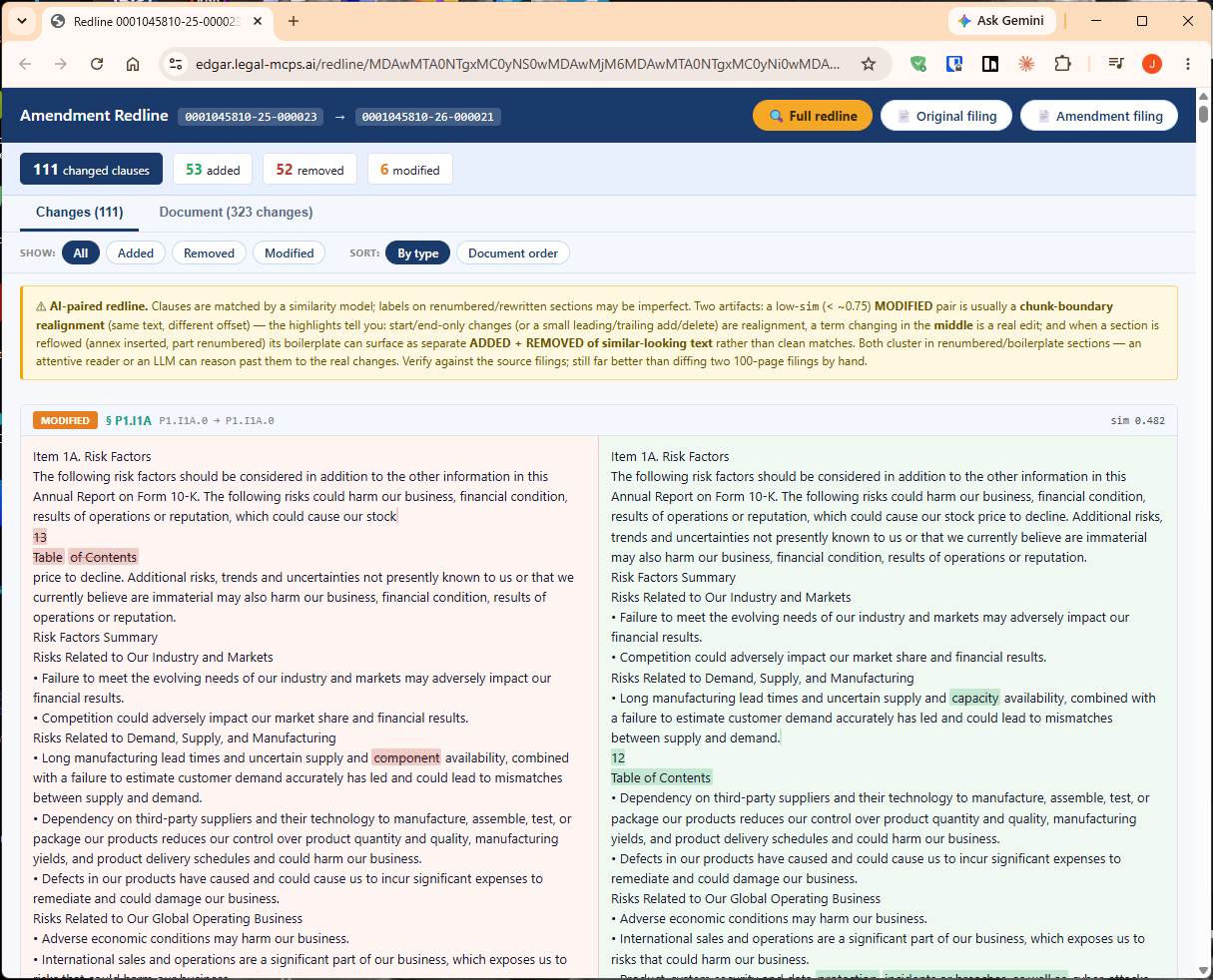
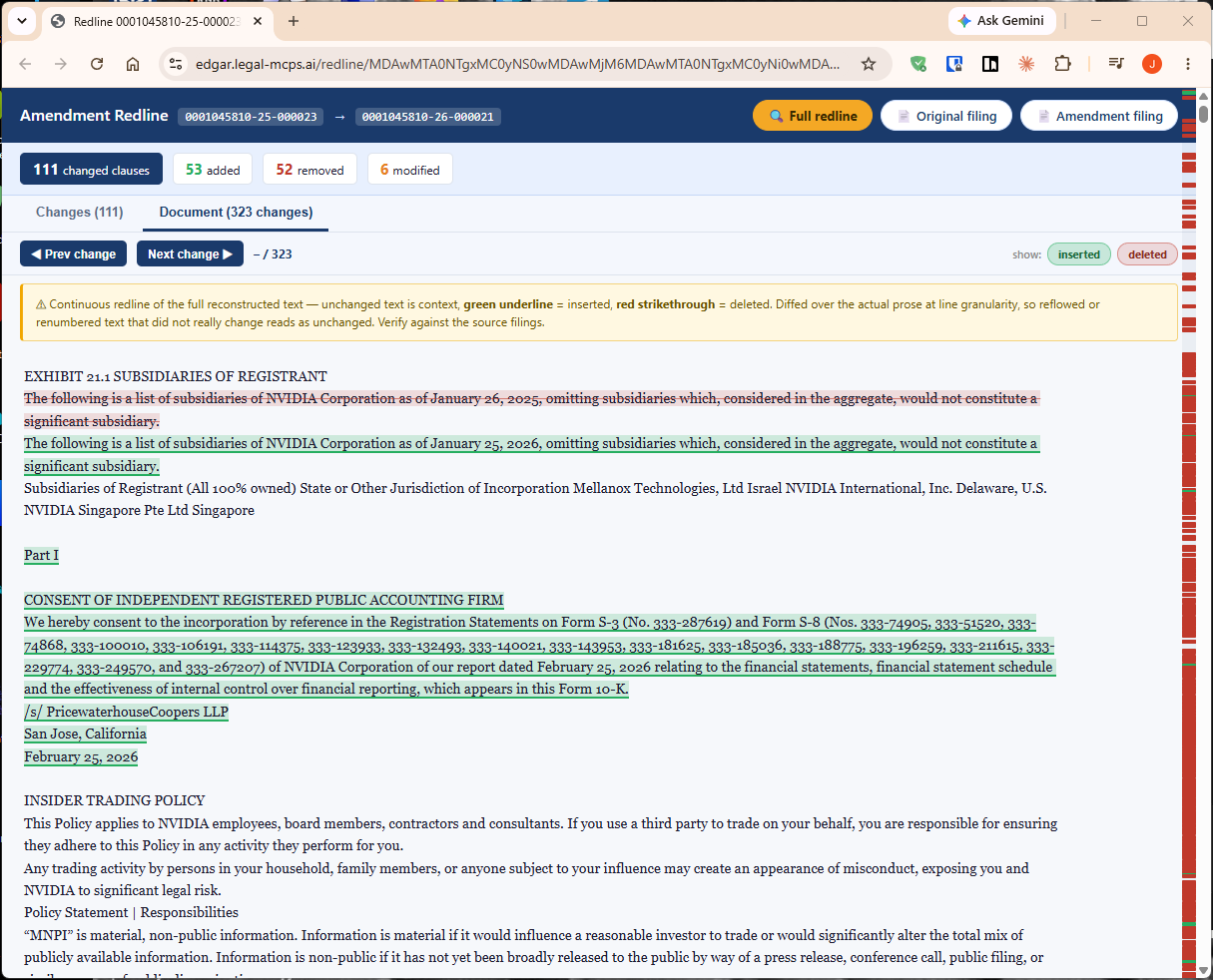
The two tabs will not agree on a count, and that is the design rather than a defect. One is asking which clauses differ; the other is asking which words differ. On a filing that has been reformatted between years, those are genuinely different questions, and having both is how you tell reorganization apart from revision.
One actual answer to this step's comparison is kept whole, captured from the production corpus on 31 August 2026: open the captured redline to see both tabs live, the ranked changes and the continuous full-document view.
Step 8: see whether the supplier holds the customer
Text is one lane. Ownership is another, and it is deterministic: every manager that files a Form 13F reports its long US-listed positions on a quarterly information table, and the corpus stores those tables as rows rather than as prose. A supplier's own 13F is where you find out whether it has money in the customer that depends on it.
Prompt 8 of 9
Does NVIDIA hold SpaceX stock? How much as of the latest quarter, and what does that stake tell me, and not tell me, about SpaceX's GPU dependency?
What you should get: yes, from NVIDIA's own 13F for the quarter ended 30 June 2026, filed 14 August: 122,764,805 SpaceX Class A shares reported at $20,975,594,582, with sole investment and voting discretion. That is the latest quarter on file; the next 13F is not due until mid-November. The arithmetic around it should come from the calculator: about $170.86 a share, and about 33% of the $63.4 billion NVIDIA reports across eight positions.
A good answer keeps two things apart. The stake is a fact from a deterministic table; what it implies about supply is not. A 13F reports a holding, not a supply relationship, and says nothing about how many GPUs SpaceX buys or from whom: the evidence of the dependency is in SpaceX's own filings. The run this step comes from also checked the Schedule 13G filings on SpaceX (Musk 48.4%, Alphabet 7.2%, Gracias 6.5%, Thiel 5.5%), found NVIDIA was not among them, and estimated its stake at roughly 1.6% of the Class A, labeled as a rough estimate. The tool also says that its data covers only the managers loaded into this corpus, so holder counts and totals are floors, not the market-wide picture.
Institutional Holders — 13F ownership
| Security | Value | Amount | % of portfolio | Discretion |
|---|---|---|---|---|
| SPACE EXPLORATION TECHN CORP 84615Q103 · CLASS A COM STK |
$20.98B | 122,764,805 SH | SOLE |
| Filed | Form | CIK Filer | Items / Doc | Accession |
|---|---|---|---|---|
| 2026-08-26 | 10-Q | 0001045810-26-000075 | ||
| 2026-08-14 | 13F-HR | 0001045810-26-000065 | ||
| 2026-05-20 | 10-Q | 0001045810-26-000052 | ||
| 2026-05-15 | 13F-HR | 0001045810-26-000042 |
In this mockup the FORM and SHOW pills are not clickable. In the product they filter the rows by form type and to amendments only. The accession links are live: they open the filing index on sec.gov.
The two panels in this step are the ones the case study carries, fed by the same calls. They are live here, like the others on this page: sort the facts table, filter the diff, open the lineage group, follow an accession to sec.gov.
Step 9: write it up
Name the subject explicitly. By this point the conversation has covered two companies, and an instruction to write up "the dependency" is ambiguous enough to get you a memo about the wrong one. It did exactly that the first time we ran this.
Prompt 9 of 9
Write a short client memo on SpaceX's dependency on GPU supply, with NVIDIA's customer concentration and its stake in SpaceX as context. Re-pull anything you need rather than relying on memory. Cover: the dependency in one paragraph; what SpaceX has contracted (compute deals, counterparties, cancellation terms) and what it hasn't (its own chip supply); and what NVIDIA's stake does and doesn't change. Link every factual claim to its source passage; a footnote without a link doesn't count. End with what this analysis does not establish, and anything you inferred rather than read in a filing.
What you should get: a sourced memo covering both companies, with an explicit limitations section, and every citation a link you can click through to the filing. The memo this page keeps is the third run's, a three-page Word document with 49 links. It states the dependency in one paragraph; sets out the Anthropic, Google and Cursor arrangements and their cancellation terms; lists what SpaceX has committed to buy (non-cancelable commitments of $27,955 million at 30 June 2026, from the 10-Q) and what it has not (any long-term chip supply contract, and a Terafab project it says may not succeed); and gives NVIDIA's concentration and stake as context. Before writing, it re-pulled its sources from the connector rather than reuse its earlier answers. The other two runs wrote theirs as a Claude Doc.
Read the whole memo ↗ Download the Word file
Those last two instructions matter more than they look. Asking for the boundary of an analysis, and for its inferences to be separated from what was actually read, is how you find out whether the assistant has a boundary at all. This one did. From its "does not establish" section:
Who supplies SpaceX's GPUs, and in what volume. The filings name NVIDIA GPUs only as the hardware in capacity sold to Anthropic and Google. My searches of SpaceX's filings for a supply agreement with NVIDIA found none, but "not found by these searches" is not proof that none exists.
And from the list of what it inferred rather than read:
NVIDIA's ownership percentage, roughly 1.6% of the Class A. I divided NVIDIA's shares by the share count implied by Alphabet's 13G (551,189,500 shares reported as 7.2%). Musk's 13G (6,418,547,515 shares, 48.4%) implies a different base, so treat the 1.6% as rough.
What you just used
That workflow moved across six different retrieval methods without you naming any of them. Narrative language came from a hybrid keyword-and-meaning search over filings, offering documents and slide images. The exact figures came from a structured financial database, not from reading numbers out of text. The arithmetic came from a calculator. The year-over-year comparison came from a clause-level document diff. The ownership answer came from a table of 13F information-table rows, filed by the holders themselves. And every result was pinned to a single company by a curated identity layer that knows which filings belong to whom.
The assistant chose those tools itself, from plain questions. Here is what it reached for in the run each step above comes from, and where the other two runs went another way:
| Step | What it called, unprompted | Where another run routed differently |
|---|---|---|
| 1 | edgar_resolve_parties_to_cik with your question, then edgar_build_issuer_timeline, as the plan it got back proposed | One run passed only the company name, got no plan, and called the timeline anyway |
| 2 | edgar_strategic_search across both text lanes, then edgar_search_filings pinned to the prospectus's risk factors and then to the 10-Q | The other two used edgar_search_filings alone |
| 3 | edgar_strategic_search twice and edgar_search_filings twice, pinned to the final prospectus | One run searched the two lanes separately (edgar_search_context_documents and edgar_search_filings) and read the Google free-writing prospectus whole with edgar_download_exhibit_text |
| 4 | edgar_diff_filings, prospectus against 10-Q, then edgar_search_filings on each | The other two used edgar_search_filings alone |
| 5 | edgar_query_financial_facts twice, then edgar_calculate for every figure | One run pulled the same facts and did the arithmetic in its own code sandbox rather than the connector's calculator |
| 6 | edgar_resolve_parties_to_cik with your question, then edgar_search_filings pinned to the 10-Ks and then the 10-Qs | The other two also pulled NVIDIA's tagged concentration figures with edgar_query_financial_facts; in one of them the plan had proposed edgar_strategic_search |
| 7 | edgar_risk_diff, then edgar_diff_filings, then edgar_search_filings six times to check each candidate against the prior year | One run skipped edgar_risk_diff and went straight to edgar_diff_filings |
| 8 | edgar_query_institutional_ownership from NVIDIA's side, edgar_build_issuer_timeline, edgar_strategic_search, edgar_query_stake_disclosures, then edgar_calculate | One run tried edgar_query_financial_facts for a share count; another did its arithmetic in its code sandbox |
| 9 | Fresh edgar_search_filings, edgar_strategic_search, edgar_query_institutional_ownership and edgar_query_stake_disclosures calls, re-pulling rather than trusting earlier answers, then a Word document | The other two wrote the memo as a Claude Doc |
Step 3 is worth noticing because the runs disagreed on method: the same prompt was answered by two different search strategies, and both found the agreements and the same gap in the final prospectus. Step 7 is worth noticing because nobody asked for it. The assistant used the comparison to find what changed and then went back to the filings to prove how, because a clause-level diff is good at spotting difference and bad at judging significance. That is the right instinct, and it is the same one an experienced associate has.
The worked result replays these runs step by step: the answers as they came back, and the method behind each one.
One honest note. Search results are ranked by an AI model, and document summaries are AI-generated. Quoted filing text and XBRL figures are not: they come from the filings themselves. Every result the tool returns carries a notice saying which is which, and a link to the source filing. When something matters, open the filing.